Organization review
Legal name, country, and contact are checked before posting, bidding, listing, or signing.
Publish your compute demand, compare provider bids, or list available supply. Accepted bids record price, SLA, rental window, and bid history for contracting.
Browse before signing up. Marketplace review is required to post, bid, list, or sign.
Live market snapshot
Track current capacity before opening a request or listing GPUs.
Open marketplaceRegional supply
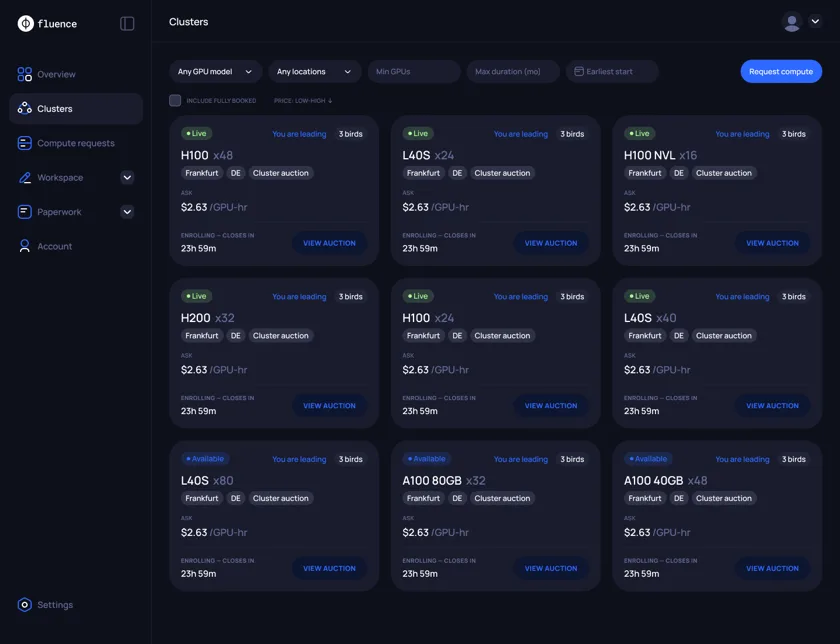
Compare available GPU supply by geography, hardware, availability, and entry rate before posting a request or placing a bid.
North America
2,112
2,112 /2,112 GPUs available
B300 x1,088 avail
$3.80
H100 x512 avail
$1.95
Europe
0
0 /0 GPUs available
No listed supply
Asia Pacific
80
80 /80 GPUs available
H200 x80 avail
$2.13
H200 x80 avail
$2.13
Middle East
0
0 /0 GPUs available
No listed supply
South America
0
0 /0 GPUs available
No listed supply
Africa
0
0 /0 GPUs available
No listed supply
Market friction
Capacity changes quickly. Pricing depends on model, region, fabric, term, start date, and provider availability. Without a structured market, buyers struggle to compare offers and providers miss qualified demand.
Capacity sits across providers, regions, and private networks.
Buyers often receive one quote instead of a competitive market view.
Spreadsheets, calls, and DMs do not preserve clean bid history.
How it works
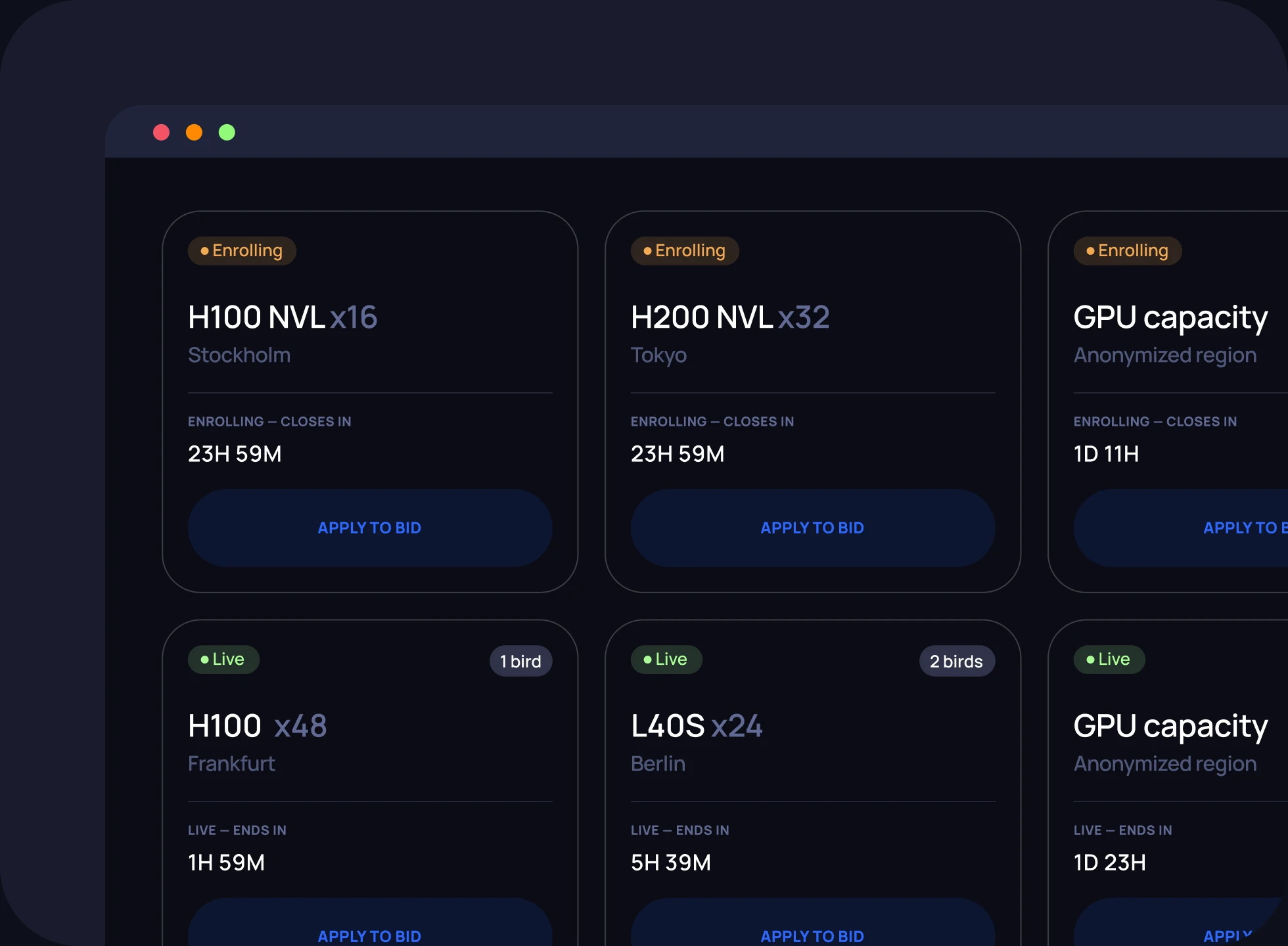
Buyers run reverse auctions. Providers run forward auctions. Both paths end with an accepted deal record.
Define GPU model, quantity, region, dates, budget, and bidding window.
Reviewed providers compete on price, availability, and terms.
Review price, region, SLA, fabric, deployment model, and provider notes.
The accepted bid records price, SLA, rental window, and bid history for contracting.
Define GPU model, quantity, region, dates, budget, and bidding window.
Qualified buyers bid for available capacity during your listing window.
Accept one buyer, split supply, or reject bids below your floor.
Accepted terms become the shared deal record for the next workflow.
Bid comparison
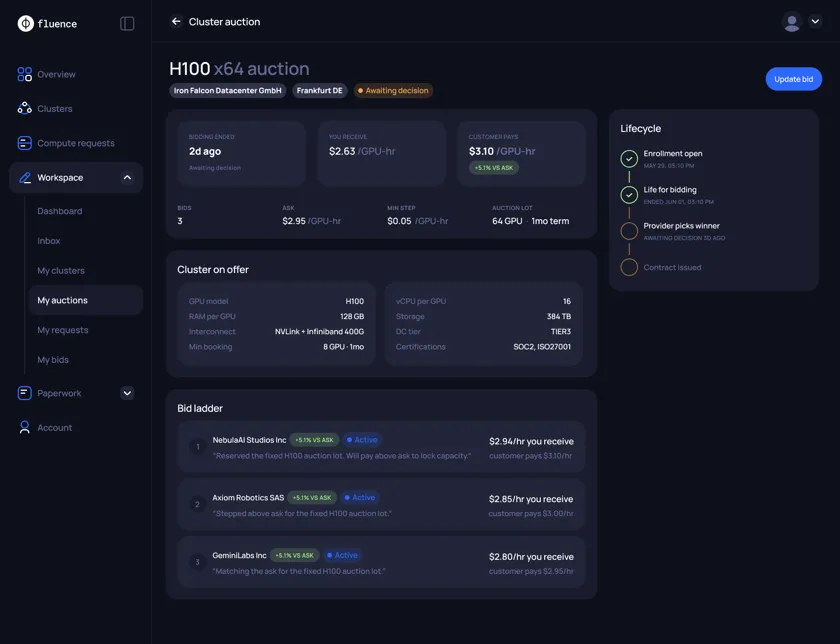
The lowest GPU per-hour rate might not always be the best option. Fabric, region, availability, SLA, and deployment model can change the real value of a bid. Compare bids across technical, commercial, and operational fit.
Why Fluence
Fluence gives buyers and providers a structured venue to price capacity, expose supply, and move accepted bids into contract workflows.
Buyers see competing bids, not a single opaque quote.
Providers set supply, terms, floors, and auction windows.
Source capacity without defaulting to one cloud vendor.
Accepted bids preserve price, SLA, window, and bid trail.
Built for teams tracking GPU spend closely.
Buy, sell, bid, list, and sign from one reviewed organization.
Marketplace trust
Reserved GPU deals carry commercial and operational risk. Fluence reviews organizations before market actions and keeps identities masked until the deal stage.
Legal name, country, and contact are checked before posting, bidding, listing, or signing.
Buyer and provider names stay hidden during discovery and bidding.
Buyers see ranked bids. Providers see their own position.
Accepted terms are preserved for contracting.
Supply must include spec, location, dates, rate, and terms.
Post demand, list supply, or browse the current market